Decks don't fail because Montana is mean — though it is. They fail because somebody skipped a step they were betting you'd never see. The boards on top can look great for years while the structure underneath is quietly losing the fight.
After enough repairs and rebuilds, the pattern is boringly consistent. Five failure modes, over and over. Here they are.
1. Frost Heave: Footings That Don't Reach Deep Enough
In the Flathead Valley, frost works its way at least three feet into the ground. Any footing that stops short of that gets grabbed by the freeze every winter, lifted, then dropped again in spring. Inch by inch, season by season, the deck racks itself apart — posts shift, the frame twists, doors of attached structures stop closing square.
The spec: footings must reach below the frost line — at least 3 feet here, no exceptions. The teardown we describe below had footings barely one foot deep. That single shortcut, invisible the day the deck was finished, doomed the entire structure.
2. The Wrong Lumber
A lot of crews frame with soft pressure-treated pine because it's what's cheap and stacked by the door. Soft pine doesn't hold its shape through Montana freeze-thaw cycles — it warps, twists, and checks, and the deck surface telegraphs every bit of it.
The spec: fir or larch framing. Denser, more stable lumber that holds its lines through the seasons. It costs more per stick, and it's one of the quiet differences between a deck that stays flat and one that develops a personality.
3. Screws-Only Fastening
This one scares us most, because it's a safety issue. Screws are great at holding things tight, but they have near-zero shear strength — load them sideways and they snap. A deck is a sideways-load machine: snow piling up, people gathering, the structure expanding and contracting all year.
The spec: structural hardware. Joist hangers, rated connectors, hardware designed to carry shear loads. On our framing, screws hold trim — steel hardware holds structure. That's non-negotiable, on every job.
4. Missing Water Management
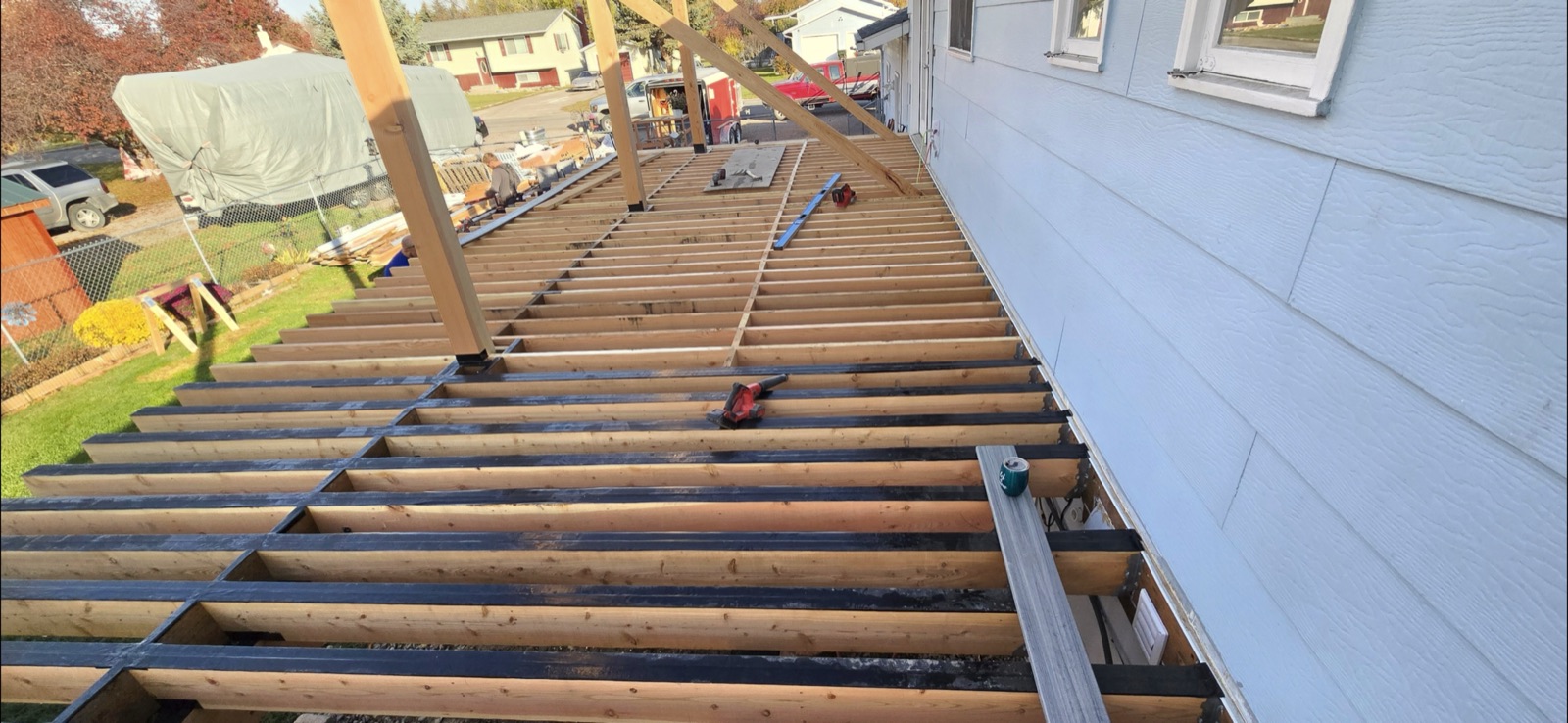
Wood structure doesn't rot from rain hitting it. It rots from water sitting in it — soaking into the top edge of every joist and beam through every fastener hole, with no way out. No flashing, no joist tape, and the frame starts rotting from the inside while the deck boards above still look fine. By the time you can feel the bounce underfoot, the damage is years deep.
The spec: flashing and protective tape on the framing — every joist top, every beam top. It's cheap insurance the homeowner never sees, which is exactly why corner-cutters skip it.
5. Composite Framed Outside the Manufacturer's Spec
Composite boards are only as good as the frame under them, and every manufacturer publishes exact framing requirements — which vary by product line. Build outside that spec and two things happen. First, the boards start to wave and warp within one to three years. Second — and this is the part that stings — the warranty is void. The install itself disqualified the coverage before the homeowner ever spent a night on the deck.
The spec: framing built to the product line's published requirements, every line, every time. It's the core of what TrexPro Platinum certification verifies, and it's why we wrote a whole guide on the Trex warranty most homeowners never actually get.
Case Study: The $31,000 Deck That Was Less Than a Year Old
We got called to look at a deck that hadn't seen its first birthday. The homeowner had taken the low bid. From the lawn chairs, it still looked like a new deck.
Underneath, it was a checklist of everything above. Footings about one foot deep against a three-foot frost requirement, so the foundation was already shifting. Soft pine framing, already moving. Everything fastened with screws only — no joist hangers, no structural hardware, near-zero shear strength holding the whole thing together. Water damage working through the unprotected framing.
There was nothing worth saving. The honest answer was a full teardown and rebuild: $31,000, on top of what they'd already paid the first builder. They bought one deck and paid for two.
And here's the part worth sitting with: none of it was visible at the bid stage. The lumber looked like lumber, the crew looked like a crew, and the finished deck looked like a deck. The only warning sign was a price that looked a little too good next to everyone else's — and that's the sign most of us are wired to ignore.
"As a veteran, I was trained to do things right the first time. No shortcuts. No excuses."
The $125 Problem
Here's the uncomfortable context behind all of this: in Montana, contractor registration costs $125. No testing. No experience required. The person who built that $31,000 mistake was every bit as "registered" as the most careful builder in the valley.
That means the paper protects you less here than almost anywhere, and the questions you ask protect you more. Ask every bidder how deep their footings go, what lumber they frame with, what hardware they fasten with, and how they manage water — and make them answer in writing. We put together the exact list: How to Choose a Deck Builder in Kalispell — 7 Questions That Separate Pros From Pretenders.
And if you're staring at an existing deck in Columbia Falls or anywhere in the valley wondering which list it's on — have us take a look or call (406) 871-8101. If it's solid, we'll tell you that too.